
Top 6 cycling routes in The Netherlands
When visiting the Netherlands you only want the best of the best in regards to highlights and sights. The following routes will take you along the country and make sure you experience the cycle culture in the Netherlands. Which bike route is your favorite?
#1 The tulip fields route (Bollenstreek)
Season: mid-March to early May (the only time you should cycle this route else you miss out on the tulips flowering)
The Bollenstreek between Leiden and Haarlem is the beating heart of Dutch flower culture. In spring, entire fields explode in stripes of red, yellow, and purple tulips, often planted in precise rows that look like a painter’s palette from above. Farmers change the colors each year, so no two seasons look the same. A quirky fact: most tulips are grown for their bulbs, not the flowers, which means the blossoms are often “topped” in May to strengthen the plant. Along the way, stop at Keukenhof Gardens, known as the world’s largest flower garden, or visit De Zwarte Tulp museum in Lisse to dive into the history of this once-pricey flower that caused the “Tulip Mania” of the 17th century. Read more on the best tulips fields in The Netherlands.
Length: about 30–40 km (round trip between Leiden, Lisse, and Hillegom)
Variation: Can be shortened to ~15 km just around Keukenhof, or extended north toward Haarlem for ~60 km.
Join a countryside cycling tour
Zaanse Schans countryside bike tour from Amsterdam
Meet in Amsterdam and travel by train to Zaandam for a guided bike ride. Review the route, cycling requirements and included train travel.
Zaanse Schans countryside bike tour from Amsterdam on GetYourGuide#2 The dunes and beach route (Zandvoort to Scheveningen)
Best for: sea views, fresh air, and lively beach stops
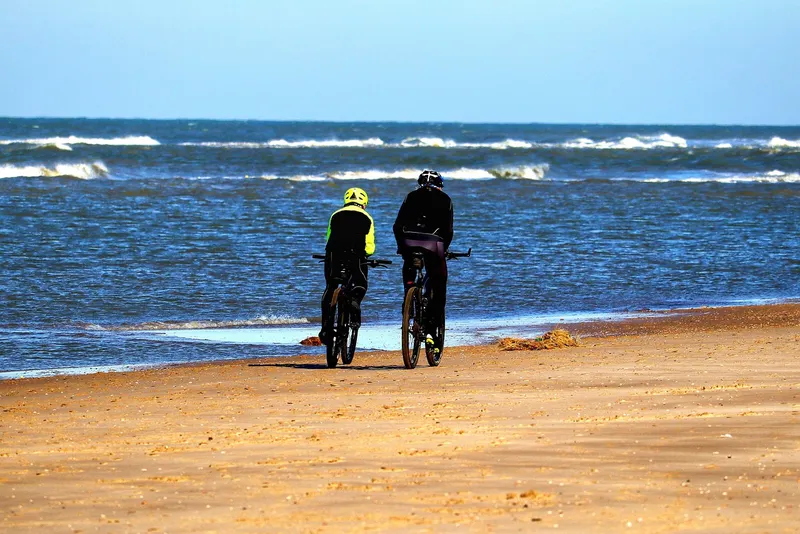
This route lets you breathe in the salty North Sea air while riding through Zuid-Kennemerland National Park. You might spot shaggy Scottish Highland cattle or wild deer grazing among the dunes. Once you reach the coast, long stretches of sandy beach await Zandvoort is famous for its Formula 1 circuit, while Scheveningen is the most popular seaside resort with a pier and Ferris wheel. A local tip: try a broodje haring (raw herring sandwich) at a beach kiosk; it’s a Dutch delicacy often eaten standing up, holding the fish by its tail. In summer, beach clubs pop up along the coast, creating a mix of Ibiza-style vibes with Dutch practicality you’ll find bike racks right in the sand. I like the Zwarte Pad area near Schevening and Bloemendaal a lot.
Length: about 40–45 km along the coast
Variation: A shorter Zandvoort–Katwijk loop is ~25 km; full coastal ride up to Scheveningen and back can reach 70+ km.
#3 The windmill and water route (Kinderdijk & Alblasserwaard)
Best for: iconic Dutch heritage
Nothing captures the essence of The Netherlands like the 19 historic windmills of Kinderdijk, built in the 18th century to keep the land dry. The surrounding Alblasserwaard polder is a classic postcard setting with grazing cows, flat meadows, and quiet dike roads. Start in Dordrecht, the oldest city in Holland, where medieval warehouses line the rivers. Fun fact: locals in this area often give directions based on dikes and waterways rather than streets. Visit in early morning or late evening to avoid tourist crowds and to catch the windmills reflected perfectly in the canals. If you’re lucky, you might also see one of the mills turning something that still happens when water levels rise. Be sure to check out our Dutch windmill guide.
Length: around 35 km if starting in Dordrecht and looping through Kinderdijk (free entrance)
Variation: A smaller local loop just around the windmills is ~15 km; extending across the Alblasserwaard polders makes it 50+ km.
Where to stay for a cycling holiday
Compare accommodation and check the distance to your chosen route. Ask the property about bike storage and any charging facilities you need.
#4 The Veluwe National Park loop
Best for: forests, wildlife, and art
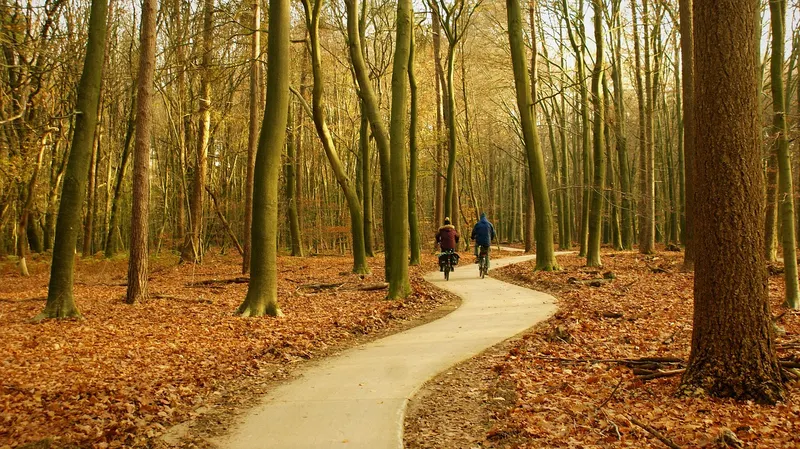
The Veluwe is the largest stretch of continuous nature in The Netherlands, famous for its purple heathlands that bloom in late summer. Inside De Hoge Veluwe National Park the #1 park in NL, more than 1,800 free white bikes are available, making it one of the easiest ways to explore. You might spot red deer, wild boar, or foxes if you’re quiet. Right in the middle of the park sits the Kröller-Müller Museum, which combines modern art with outdoor sculptures hidden among the trees. A local detail: many Dutch families come here for a day out with picnic baskets strapped to their bikes, a tradition that hasn’t changed for generations.
Length: 25–40 km depending on chosen trails inside the park
Variation: With detours to villages like Otterlo or Arnhem, you can stretch it to 60+ km.
#5 The Zuiderzee route (IJsselmeer loop)
Best for: multi-day cycling trips
Before the Afsluitdijk was built in 1932, the IJsselmeer was a saltwater sea called the Zuiderzee. Today, the dikes and fishing villages tell the story of how the Dutch literally reshaped their country. Cycling here feels like stepping back in time: in Hoorn and Enkhuizen you’ll see ornate 17th-century buildings from the Golden Age, while Marken and Volendam are known for their wooden houses and traditional costumes. A fun fact: Marken only became connected to the mainland in 1957, so its culture remained isolated for centuries. Similar thing happened to Urk also a unique place around the route. If you like cheese, make sure to stop in Edam for a tasting. The full Zuiderzee route is over 400 kilometers, but even short stretches give you that sense of history and water-filled landscapes.
Length: the full loop is ~400 km
Variation: Popular day trips cover 40–80 km, e.g., Enkhuizen–Hoorn (45 km) or Volendam–Marken–Edam (35 km).
#6 The Wadden Islands ride (Texel focus)
Best for: island vibes and endless horizons
Texel is just a 20-minute ferry ride from Den Helder but feels like another world. Its 60-kilometer cycling loop takes you past the Eierland lighthouse, wide sandy beaches, and nature reserves buzzing with birdlife. Texel is known for its sheep there are more of them than humans and you’ll find Texel lamb on many local menus. A fun local detail: the island even has its own brewery, Texels, which produces beers like “Skuumkoppe,” a dark wheat beer named after the foamy waves of the North Sea. The pace of life here is slow, making it perfect for a relaxed day of cycling with sea breezes and wide horizons. This is my favorite Wadden island to bike.
Length: the full island loop is ~60 km
Variation: Shorter routes around Den Burg or the southern dunes are 20–30 km; full northern loop including lighthouse adds the rest.
Bonus cycle tips
Bike shops rent out city bikes and, often, e-bikes. Book ahead if you need a child seat, cargo bike or a particular frame size. Start with a short route if you are unfamiliar with Dutch cycle traffic, and ask the rental shop about quieter roads and safe parking.
Practical tips for cycling like a Dutch local
- Rent a proper Dutch bike – city bikes (omafiets) are fun for short trips, but for longer distances rent a sturdy touring bike or an e-bike.
- Use the knooppunten system – these numbered junctions are like Lego blocks for routes: pick your start, connect the numbers, and never worry about getting lost.
- Pack like a local – Dutch weather is famously unpredictable. A rain jacket and layered clothing are essential, but also bring sunglasses for those magical clear days.
- Respect the rules – cycle on the right, use hand signals for turns, and don’t block bike paths if you stop. Dutch cyclists can be fast and direct don’t take it personally!
- Lock your bike – locking your bike is essential in the big cities as theft for bikes is common. Think every Dutch person has their bike stolen at least once in their life, heck mine got stole 3 times already.
- Stop for treats – roadside cafés and farm stalls are everywhere. Try poffertjes (mini pancakes), boerenkaas (farmhouse cheese), or a slice of appeltaart with whipped cream.
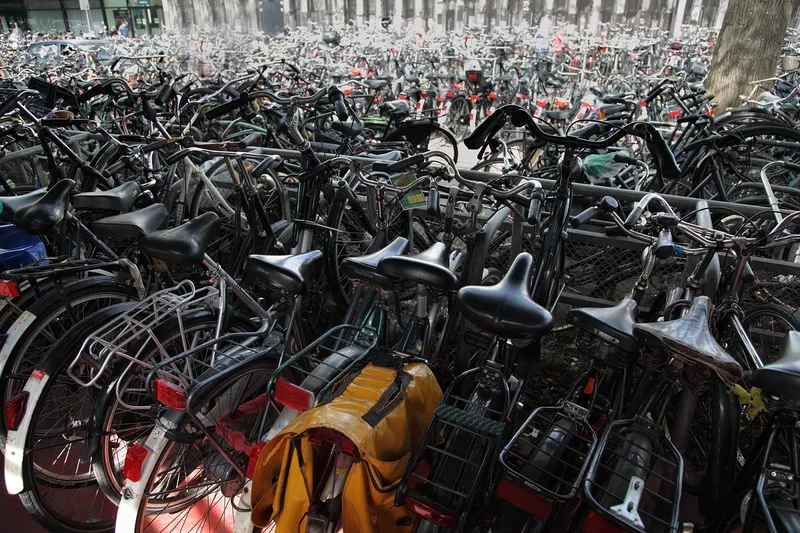
Bikes are everyday transport in the Netherlands: people use them for school, shopping and the commute. Cargo bikes, known as bakfietsen, are a familiar sight, and large stations have extensive bicycle parking. As a visitor, you can join in without covering a long distance. A short ride on a quiet route is a good first step.
Do I need to wear a helmet in The Netherlands?
Helmets are not generally required for ordinary bicycles or standard pedal-assist e-bikes with assistance up to 25 km/h. Speed pedelecs, which can provide assistance up to 45 km/h, require an approved helmet. A helmet is still a sensible precaution on other bikes. When renting, ask which type of bike you are getting and which rules apply.
Can I take my bike on trains?
Yes, outside of rush hours. You’ll need a bike day ticket (fietsticket). Foldable bikes travel free (also in rush hours).
What’s the best time of year for cycling in The Netherlands?
Spring for tulips, summer for beaches, and autumn for forests. Winter cycling is possible but often wet and windy.
How safe is cycling for beginners?
Very safe. The Netherlands has some of the most extensive and well-marked cycle paths in the world, with cars used to giving way.
Are there guided cycling tours?
Yes, from Amsterdam city rides to multi-day cultural and nature tours. It’s a great way to learn local history while avoiding navigation stress.